FTSE Finish Line: July 6 — Four-Month High Fades as Construction Slump Revives Growth Concerns
FTSE Finish Line: July 6 — Four-Month High Fades as Construction Slump Revives Growth Concerns
London started the week with an early push to a fresh four-month high, but the move failed to hold. After a flat open and a subsequent rally, the FTSE 100 slipped into negative territory on Monday as investors turned more cautious following another weak reading from the UK construction sector. The market tone was not outright bearish, but the early reversal mattered. The benchmark’s failure to sustain a breakout suggested investors remain reluctant to chase UK equities higher while domestic activity data continue to weaken, political uncertainty persists and the Bank of England remains in wait-and-see mode rather than moving toward rate cuts. The latest data reinforced that caution. S&P Global’s construction PMI came in at 38.4 in June, only slightly above May’s six-year low of 38.2 and still deep in contraction territory. The reading showed that construction remains one of the weakest parts of the UK economy, weighed down by elevated financing costs, weak project starts and subdued confidence. That follows last week’s services PMI contraction and earlier softness in mortgage approvals and house prices. Taken together, the message is clear: the UK economy is not collapsing, but several rate-sensitive sectors are under real pressure. Construction, housing and parts of consumer services are all showing the delayed impact of restrictive monetary policy and elevated gilt yields.
The stock-level picture reflected that hesitation. Halma fell 2.5% and Fresnillo dropped 2.4%. Airtel Africa, Associated British Foods, IMI, Diploma, Spirax, Games Workshop, Whitbread, InterContinental Hotels Group and Smiths Group lost between 1.5% and 2%. Centrica, Rolls-Royce, AstraZeneca, Coca-Cola Europacific Partners, SSE, Segro and Compass also moved notably lower. Ocado was among the weakest names, falling more than 3%. The online grocery and technology group announced that Tim Steiner would continue as chief executive until the start of the 2028 financial year. The market reaction suggested investors remain focused on execution risk, valuation and the pace at which Ocado can convert its technology platform into more durable profitability. There were still important pockets of strength. RELX, St. James’s Place, Experian, Barratt Redrow, LSEG, BAE Systems, Abrdn and IAG rose between 1.5% and 2.7%. IG Group, Pershing Square Holdings, Prudential, Burberry, Pearson, Admiral and Computacenter gained between 0.7% and 1.3%.The gain in Barratt Redrow was notable given the weak construction PMI. It suggests some investors are looking through the near-term data weakness and positioning for eventual rate relief or policy support. But the broader housing and construction backdrop remains difficult, and any recovery will likely depend on lower mortgage rates, improved confidence and a more predictable fiscal outlook. The standout move came from easyJet, which soared 11% after the British budget airline agreed in principle to a takeover offer worth around £5.2 billion from U.S. investment firm Castlelake. The bid reinforced a recurring theme in UK markets: overseas buyers continue to see value in London-listed assets, particularly where public-market valuations remain depressed relative to strategic or private-market interest. The autos data were more encouraging. The Society of Motor Manufacturers and Traders said UK new car sales rose 11.4% year-on-year to 213,166 units in June, the best June performance since 2019. That suggests parts of the consumer and business spending cycle are still holding up, helped by fleet demand and replacement activity. However, the strength in car registrations was not enough to offset the broader concern created by weak construction activity.
Attention now turns to Tuesday’s Bank of England Financial Stability Review. Markets will focus closely on the Financial Policy Committee’s leverage framework review, which was launched after the December 2025 capital assessment. In that review, the FPC cut its system-wide Tier 1 benchmark from 14% to 13% of risk-weighted assets, having concluded that UK banks are comfortably capitalised. It also identified leverage ratio calibration and buffer usability as priority workstreams for 2026. The base case is that the FPC announces reforms to the Additional Leverage Ratio Buffer and Countercyclical Leverage Ratio Buffer. The aim would be to reduce how often leverage requirements become the binding constraint for banks that hold larger volumes of lower-risk assets. This is especially relevant ahead of Basel 3.1, which is expected to lower average risk weights and could therefore make leverage requirements bind more frequently unless the framework is recalibrated. For markets, the implications would be modestly constructive. Reform could increase bank balance-sheet capacity, reduce the risk of leverage constraints becoming binding under Basel 3.1, and support financial intermediation. It could also improve banks’ ability to hold gilts outright, which would provide an incremental bid for UK government bonds. That potential gilt bid matters. With gilt yields still elevated and fiscal credibility central to the political transition, any regulatory change that supports demand for gilts could help at the margin. It may also support fiscal savings over time by easing some pressure on government borrowing costs. However, the effect should not be overstated. The scale of outright gilt demand and fiscal saving is likely to be materially smaller than some optimistic estimates, and the benefits would probably be spread across the curve and over time. There is also a political dimension. The FPC’s review aligns with the growth and competitiveness agenda highlighted in the Chancellor’s 2024 Mansion House speech, which called for the FPC to embed its secondary objective more fully. Narrowing the gap between the UK leverage framework and less restrictive peer regimes would fit that mandate, particularly if it frees capacity for lending, market-making and gilt absorption without weakening financial resilience. Still, regulatory support is not a cure-all. The market remains sensitive to political uncertainty as Andy Burnham moves closer to becoming prime minister. Investors continue to focus on who becomes Chancellor, how the new government funds its priorities, how it manages union expectations and whether it can maintain the fiscal discipline that initially calmed sterling and gilts.The Bank of England backdrop also remains complicated. Governor Andrew Bailey has signalled that rate cuts remain off the table for now due to concerns over delayed energy-price pass-through, even as activity weakens. Catherine Mann has gone further, arguing for a longer hold and warning that inflation persistence may require the Bank to lean against price risks. That leaves markets stuck between weak growth and sticky inflation risk.
Finish Line: The FTSE 100 briefly reached a four-month high but reversed into negative territory as another weak construction PMI reminded investors that the UK’s rate-sensitive economy remains under strain. easyJet surged on a £5.2 billion takeover approach, and autos data showed stronger new car sales, but the broader index was held back by construction weakness, mixed sector performance and caution ahead of the BoE’s Financial Stability Review. A leverage-rule recalibration could modestly support banks and gilts, but it is unlikely to overwhelm the bigger forces still driving UK assets: weak domestic growth, elevated yields, sticky inflation risk and the political transition toward a Burnham premiership.
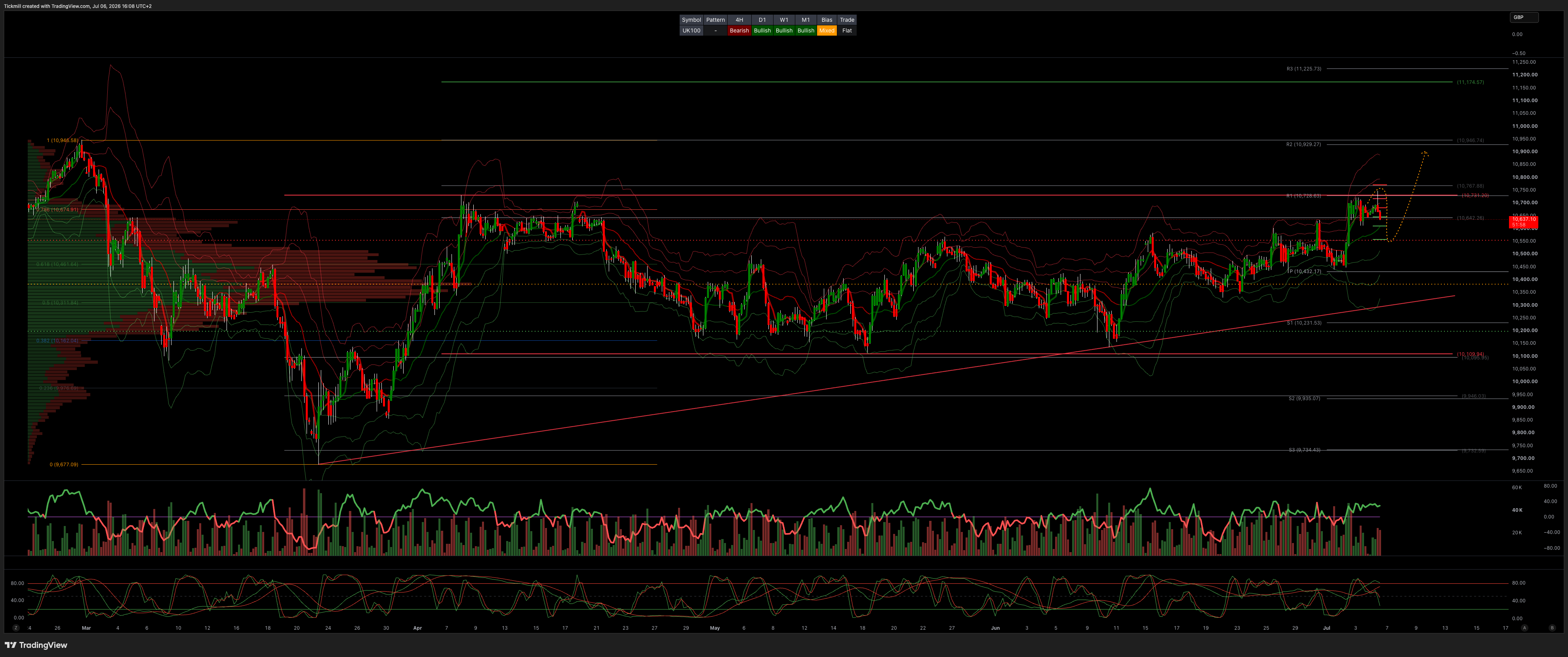
TECHNICAL & TRADE VIEW – FTSE100
Daily VWAP Bullish
Weekly VWAP Bullish
Above 10300 Target 11000
Below 10100 Target 9469
Disclaimer: The material provided is for information purposes only and should not be considered as investment advice. The views, information, or opinions expressed in the text belong solely to the author, and not to the author’s employer, organization, committee or other group or individual or company.
Past performance is not indicative of future results.
High Risk Warning: CFDs are complex instruments and come with a high risk of losing money rapidly due to leverage. 69% and 73% of retail investor accounts lose money when trading CFDs with Tickmill UK Ltd and Tickmill Europe Ltd respectively. You should consider whether you understand how CFDs work and whether you can afford to take the high risk of losing your money.
Futures and Options: Trading futures and options on margin carries a high degree of risk and may result in losses exceeding your initial investment. These products are not suitable for all investors. Ensure you fully understand the risks and take appropriate care to manage your risk.
Patrick has been involved in the financial markets for well over a decade as a self-educated professional trader and money manager. Flitting between the roles of market commentator, analyst and mentor, Patrick has improved the technical skills and psychological stance of literally hundreds of traders – coaching them to become savvy market operators!