Institutional Insights: Goldman Sachs BTC's Geopolitical Reaction Function
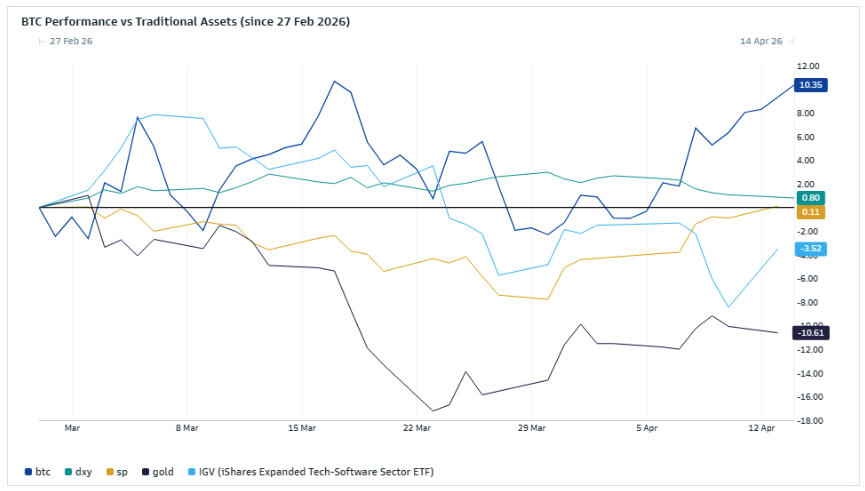
BTC has risen more than 10% since 27 February, outperforming many traditional assets since the start of the US-Iran conflict. From Monday’s lows, BTC rallied 6% to a four-week high of $74.9k, while ETH gained 5% to $2,370, helped by improving risk sentiment around the conflict as well as continued ETF demand. Last week, US spot BTC ETFs recorded $833m of net inflows, while spot ETH ETFs saw $187m.
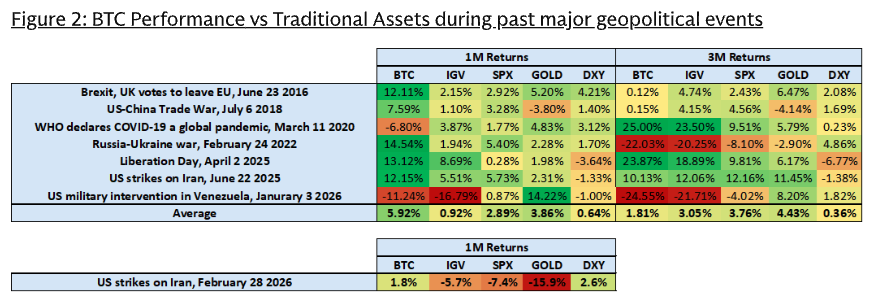
Historically, BTC has often performed well in the immediate aftermath of major geopolitical shocks. Looking across seven major events over the last decade, BTC delivered positive 1-month returns in five cases, often with a larger initial move than other risk assets. However, that strength has proved less durable over a 3-month horizon, with BTC holding onto gains or reversing losses in only two of seven cases.
One notable pattern is that BTC’s medium-term return profile tends to converge with software equities, as proxied by IGV. In other words, while BTC can trade like a high-beta geopolitical shock absorber in the short term, over time it has tended to behave more like a growth / software-linked risk asset.
The broader takeaway is that BTC’s recent resilience is directionally consistent with past geopolitical episodes, but history also suggests caution about extrapolating near-term strength too far. Outcomes are heavily shaped by the macro backdrop, and in the current episode that includes not only the US-Iran conflict, but also a unique energy and policy setting around the Strait of Hormuz.
Disclaimer: The material provided is for information purposes only and should not be considered as investment advice. The views, information, or opinions expressed in the text belong solely to the author, and not to the author’s employer, organization, committee or other group or individual or company.
Past performance is not indicative of future results.
High Risk Warning: CFDs are complex instruments and come with a high risk of losing money rapidly due to leverage. 69% and 73% of retail investor accounts lose money when trading CFDs with Tickmill UK Ltd and Tickmill Europe Ltd respectively. You should consider whether you understand how CFDs work and whether you can afford to take the high risk of losing your money.
Futures and Options: Trading futures and options on margin carries a high degree of risk and may result in losses exceeding your initial investment. These products are not suitable for all investors. Ensure you fully understand the risks and take appropriate care to manage your risk.
Patrick has been involved in the financial markets for well over a decade as a self-educated professional trader and money manager. Flitting between the roles of market commentator, analyst and mentor, Patrick has improved the technical skills and psychological stance of literally hundreds of traders – coaching them to become savvy market operators!